Monday, May 4, 2026

On Fear: The Value of Travelling and Writing with Empathy

Aside from the planting blog, I haven't written new blog posts in a while - aside from editing and retroactively posting old drafts. Part of this centres on wondering what good it would bring when there are far more important things going on in the world; what do I actually have to add? 

Last July, I read Omar El Akkad's "One Day, Everyone Will Have Always Been Against This," which came out that year, and offered sharp and damning pieces on injustice, fear, and moral contradiction in light of Israel's ongoing genocide in Palestine. The chapter on fear stood out especially strong for me. He writes about the West's catering to certain people's fear at the expense of other people. One paragraph stands out:

About the same time Democrats and Republicans argue over the bill, New York Times columnist Thomas Friedman writes a piece comparing Iran, the nation of more than 87 million, to a wasp. What laces the entire racist, nonsensical premise is fear. Everyone knows, instinctively, the recoil the sight of a wasp induces. But fear is no end in itself; its function here is to allow for the abdication of restraint - nobody has ever been blamed for wanting to swat at a wasp. It might have stung. (p. 133) 

This paragraph caught my attention because (1) it's about writing, and entire opinion pieces being granted space to harmful views, (2) the wasp metaphor came right after I'd finished a season of treeplanting and was far too familiar with goddamn wasps, and (3) the concept of fear is something I've written about before and yet, I can speak directly with many of the things the contemporary conservative right chooses to monopolize fear of. Most of those things are fundamentally misunderstood and not dangerous at all. The fear of the unknown/uncomfortable that I wrote about a few years ago is something experienced by everyone but can only be overcome by directly facing it head on - not by weaponizing it.

In the West, one of these deeply-rooted fears of the unknown is historically Muslim-dominant societies. Even in the most well-meaning (often white-dominant) progressive circles, you'll often find an unspoken fear of these countries, and the people living in them. I'm not about to discuss corrupt governments, Western or Eastern, but I am going to talk about the value that comes from facing those fears of the unknown rather than letting corporate and military interests capitalize off it.

We've all heard some variation of the claim "These bleeding heart liberals - just try going to a Muslim countries and see how you're treated there!" The thing is... I do. Most recently, I traveled solo through Turkey, Iraq, Azerbaijan, and Morocco. Before that, I've been to Palestine, Egypt, Malaysia, Kosovo, Albania, Bosnia, and Indonesia. All of these are Muslim-majority countries.

Talking about these experiences is important because, fundamentally, I am from the West and my voice reads as such. The people most likely to relate to my perspective are also from the West - and that's where this kind of writing might matter most. Most people from my conservative hometown haven't had the privilege of backpacking these countries and, furthermore, even if they did, the information and media bias we have no control over has painted many of these countries as places many wouldn't want to visit. With the information most people in the West have been fed, why would they want to visit Iraq?

I prefer traveling solo because that's the easiest way to meet someone local, to get a taste of what life is really like there. In Istanbul, I spent multiple hours at a mosque talking with a conservative Muslim because, despite obvious disagreements on some important things, we were fundamentally able to connect through deep, meaningful conversation. While waiting at the border crossing between Turkey and Iraq, a Kurdish woman held my hand for a long time, as if trying to protect from anyone who might pester us.

In Cappadocia, I met a young Saudi couple from Jeddah while on a bus tour. They were on a "second honeymoon" and defied pretty much every Western stereotype created about Saudis. The woman, wearing a strapless mini-dress, was the most scantily-clad of anyone in our group. After learning I was solo backpacking, the husband approached me and started asking questions about my trip. When I told this story to a well-meaning friend, they immediately made a face - thinking I was about to describe some creepy encounter. I'd inadvertently set up the story to cater to negative stereotypes of Arab men. I hurried to say what the man actually wanted from me: "Here, come speak with my wife." He'd wanted to go backpacking but she was hesitant; he was hoping I might be able to help change her mind. In the end, they were kind and generous, inviting me to dinner after the tour. We talked about traveling, backpacking, hostels vs. hotels, Saudi Arabia, Canada, Turkey, etc. The woman mentioned she was mildly Instagram-famous (an understatement - she had hundreds of thousands of followers) when I asked to keep in touch. Noting she wore a burka in her Instagram photos and reels, I asked what seemed a reasonable question - why, if she's in a mini dress now. She looked surprised at the question and answered "Because I'm on vacation now. Instagram is professional." Wearing a mini dress on Instagram for her would be like showing up to the office in a bikini.

What's been consistent across all my travels is this: 

Everyday. People. Everywhere. Are. Just. Like. You. And. Me. 

It's cheesy because it's so obviously true, but industry and media and politics invest so much energy into creating artificial divisions and capitalizing on people's fear of difference.

When telling these types of travel stories, there's invariably someone keen to remind me how "lucky" I am that nothing bad happened. As if people in those parts of the world are inherently violent or dark and I should count my lucky stars someone didn't abduct me. It's true that I wasn't unlucky - in the same way I've never been randomly abducted off the streets of Toronto or Geneva either. But if it's actually pure luck I was able to survive these countries unscathed, then damn - I should probably start buying lottery tickets. Apparently I have a 100% chance of success.

Or maybe the world isn't as scary as we've heard.

Saturday, July 26, 2025

"Eat Shit for Long": 2025 Planting Moments

Last year, after a 3-year hiatus, I returned for a 6th season to the world of treeplanting. This year, I came back again for a 7th, but there's a 50/50 chance I'll ever have an 8th season. Alas, here's a short story collecting a few of the more notable moments of the season. Enjoy!

The tents may be the same, but the camp is very different

Pretty much everyone from the old blogs have changed. A few people remained: Jasmine is here (one of the few who didn't get a blog name change, although she's now an assistant supervisor and no longer plants), Colin stayed (although he is now a checker), Eddie stayed (and still plants), and a spattering of others not mentioned in previous blogs. Otherwise, pretty much everyone is a fresh batch of under-30s; our supervisor is also new (okay not entirely new; he was a crew boss one of the earlier years and a co-supervisor with Rainer another year, but he took over completely in the years I was gone).

There are also a lot of changes in the way camp is run: some okay, others less so. For example, there are twice as many showers and always leftover food available on the day off (these are excellent). However, only half the crew bosses still plant and the number of non-planting staff roles has gone from 3 to about about 13 (not excellent). "Do this" his very differently when the person telling you is also doing the thing vs. one of an ever-growing group paid to boss others around without actually doing the work themselves. Leading by example is very much a thing of the planting past. Luckily, for most of the season, I'm on one of the crews lead by a foreman who does still plant.

The crew I'm on for the bulk of the season is a continual absurdist cacophony of insanity, so this story is centred on that crew. They're all getting pseudonyms, in the same style as previous planting posts (except Jas and Eddie for some reason?). We'll call the crew boss Ferdinand because he reminds me so much of Ferdinand the Friendly Bull. Just like Ferdinand the Bull preferred to sit and smell the flowers to fighting with the other bulls, Ferdinand the Foreman can often be seen sitting calmly in the middle of the block rather than planting. Then we have Bob & Doug, named for being slightly more clever versions of Bob & Doug McKenzie (NOTE: there is a Real Doug in camp, but this is not Real Doug). In the early season, Bob invariably has a touque perched at the top of his head, neck bleach pale and fully exposed; how his neck never freezes, I've no idea. Doug, on the other hand, is thoroughly protected from the cold: hoodie drawstring clinched tight around the sides of his face, concealing the varying number of warm hats beneath and essentially ballooning his head to twice its normal size. 
Bob and Doug McKenzie, Canadian icons

The one other girl on the crew is Annajo, named such because I am incredibly lazy. Annajo is full of energy and generally positive, which is a great respite from the often-depressing work of slamming your shovel into an old coal mine for 10 hours/day. The final seat in the truck tends to change.

There is one particularly terrible shift this season (but for the story's sake, I'm going to use some creative liberty to combine all 3 days, and the people in the ever-changing seat, into one). It's on the coal mines, which are rock hard and way up on the top of a (former) mountain. We also have to drive through an Autonomous Operating Zone (AOZ), in which giant haul trucks do not have drivers. This means we will spend a lot of time waiting for an escort through the AOZ.
 
Before this, however, we have a morning safety meeting (in which they steal several minutes, and therefore income, from our day to brief us about things like "stay 20m away from animals," "remember to drink water," "look out for rocks," and other things to both make themselves feel worthwhile and help the mining company avoid a lawsuit from Worksafe BC). 

Vibram soles are supposed to be the best in the business AND YET


Stumbling out of the truck in the morning, planters are tying their boots and fumbling around for their hard hats and hi-viz vests.

"Alright, Doug, let's take a look at you," Bob says, positioning his hard hat and turning toward Doug before  concluding: "You look like a fucking idiot."

Offended, Doug immediately responds: "So do you, dumbass." He then turns to gaze mournfully at his own reflection in the truck window. "Dude, we look like idiots," he laments, "All our swag's been absorbed by PPE."

Once the safety meeting is finished, we clamber back into the truck to wait for the drivers to finish their added safety meeting. While waiting, Rob, the English first-year planter currently occupying the ever-changing seat, is having a minor crisis: he needs to use the toilet but there are none around. At first, this just provokes a round of chuckles and jeers, along with a few genuine responses like "Just go find a spot, Rob" and "Hurry up and go, dammit, or you'll make us late."

Hesitating, Rob stammers, "I'll wait for Ferdinand and ask him." This immediately ignites the rest of the truck in a fresh round of giggles and guffaws.

"You wanna consult the crew boss about your shit?!" Doug starts to nearly cry with laughter.

"This is planting, Rob," Annajo offers helpfully, "You gotta just go."

"This is a carpark, Annajo," he sarcastically snaps back . More chuckles and jeers.

Panicking, Rob finally blurts: "Guy, guys, this is a Code Brown!"

"Omg just go in those bushes!"

"There's so many gaps; anyone could see through!"

"Go behind them then."

"That's the road; anyone on the highway would have fully view!"

"What about just over that hill?"

"What if there's someone on the other side?"

"Jesus Christ, do you have to go or not?"

At long last, Rob winces and finally bursts out of the truck, running full speed down the little road to the end of the hill... and keeps going... and going...

"Damn he's really going for it."

"And no shovel either?"

"He's a rookie; he's not burying anything."

"He'd better not take forever."

Eventually, the driver meeting finishes and Ferdinand re-enters the truck. "...Where's Rob?" he asks, having been, in the end, left unconsulted about Ross' shit. We wait... and wait... until nearly all the other trucks have started to pull out of the parking lot. Ferdinand starts honking.

"What's taking him so LONG?" Bob laments, climbing out of the truck to get a better look, "Seriously, did he run off to fucking Timbuktu just to take a shit? ROB!!"

Several minutes later, Rob makes his way back over the hill, climbs back into the truck, and we make our way toward the AOZ to then wait in line for another truck to escort us through. While waiting, Ferdinand looks at the desolate, bleak world of coal and shale rock all around us.

"It looks kind of like the moon," he says.

Doug frowns. "Yeah but it's way worse and it's just on earth and it sucks."

Suddenly, Bob changes the song playing from Bo Burnham to a Cosmo Sheldrake album, a very sudden shift.

"Hey wait, what's that about?" Ferdinand interjects.

"Because I like it," Bob snaps back, "Feels whimsical, motherfucker."

A few moments later, Bob and Doug are having an earnest discussion on whether or not they could successfully sneak a bomb onto an airplane.

"Naaah, I doubt it," Doug muses, "They'd catch us for sure."

"Yeah," Bob agrees matter-of-factly, "I mean, they'd probably do an anal cavity search."

"WHA-?!" Doug blurts, exasperated at the sudden turn of this formerly-serious discussion, "Bro, who the fuck is hiding a bomb in their ass?!"

"I don't know," Bob responds defensively, "it just seemed like a reasonable response."

After little over an hour of waiting, our escort arrives and we are driving through the AOZ. Looking at the massive haul trucks towering over our tiny Ford F350s, it's wild to think there's no actual human sitting inside.

Pulling up to our piece, Ferdinand informs us that (1) this is an extremely important piece and all of our trees have to be perfect, and (2) there is a blast at 4:00 that, should it be delayed, might delay when we can leave.

"No." Bob blurts decisively, "No, I'm not doing that."

"Yeah, what's the point of taking extra time to plant perfect trees without an actually-appropriate price bump," Doug agrees, albeit significantly more articulately than Bob, "and if we do get a price bump, we'll still need to put like 2000 in to make it a good day."

"And if we stay late, that means we'll have to eat shit for long!" Bob adds.

"Eat shit for long," Annajo echoes, "what a phrase."

"Look, I'll ask," Ferdinand sighs, pulling out his phone to call our supervisor while the rest of us start bagging up. A few minutes later, he comes back. "Okay, he's agreed to day rate of 400 each."

"No." Bob and Doug respond in unison, before Doug follows it up with, "we can make 500 just by putting 1500 trees in the ground. We're not putting in perfect trees for that." Ferdinand nods and pulls out his phone again, making another call to our supervisor.

When we're all fully bagged about to head into the land, Ferdinand comes back with yet another proposal. 500. Bob and Doug agree to put in "perfect trees" at the expense of numbers.

"It's a good thing Bob and Doug are always so irate," Annajo chuckles as she and I head toward our respective pieces, "I would have just taken the 400." I laugh in agreement. 400 ain't bad. Luckily, both Bob and Doug are young, energetic, and short-fused hiballers.

The land itself is terrible. Rock, really. Imagine slamming a shovel into the Canadian Shield. Or trying to spoon soup out of concrete. The earth doesn't give so much as flinch; every shovel thrust clangs like you've insulted it. But you still need to get those trees in so you just keep hitting it, over and over, like some cruel geological joke indifferent to your blisters. Actually, blisters are the least of our worries; at this point, all blisters have already formed into a thick shield of calluses. The real problems are tendonitis and tennis elbow, so we have Leukotape to restrict movement and reduce the likelihood of developing them. Also probably lung disease is up there: stabbing holes into the blown-up lungs of the earth while your own lungs fill with black dust can't possibly be great for them. The job is a delightful exercise of self-destruction in the desolate land of Mordor. We trudge, sweat, and swear our way through the day, pushing saplings into the bones of what was once a mountain.

Found this sad little collection of larches in a tiny area of dust surrounded by rocks


By 4pm, we hear that the blast was delayed. By 4:30, it's still delayed but we're too tired to keep planting overtime. Instead, we haul our sweaty, sooty, coal-coated selves into the trucks, drive to the blast guard, and wait until we can pass. We wait... and wait... and wait... The blast goes off around 6pm, but then the mines have their shift change and our escort back through the AOZ is the lowest of priorities. By 7:00pm, Annajo and I are getting hungry in the front with Ferdinand, the boys in the back seat are going loopy, and poor Ferdinand is just trying desperately to hold things together. He hands Annajo and I the leftover remnants of his lunch.

"Whatever you do, don't look back," he says seriously while passing the food. Annajo and I promptly turn around to see three pairs of legs reaching upward, boots positioned firmly on the ceiling.

"Oooh yeah that's a good stretch," moans Doug.

"Fuck, man, how did you get that far?!" gushes Bob, as Doug's legs march even further up over his head, along the ceiling, until reaching the back window of the cab.

"Stretching. Don't you stay in shape for planting?"

"Fuck no. Gotta keep it tight; gotta keep it locked in."

"I don't think that's what 'locked in' means."

Annajo and I turn back toward the windshield.

The next time we turn back is when the boys have devolved to threatening each other as a means to hold our supervisor ransom for a raise (at this point, there was no communication whether or not we'd be compensated for being stuck in the truck this long).

"Not gonna pay us?" Bob threatens our imaginary supervisor, "Oh yeah? How bout if I just kill Rob then?"

"Wait, what?" Rob starts to protest but is overpowered.

"Or what about Bomboclat?" Bob continues growling, "Seen him recently? No? Better start looking."

"Who's Bomboclat?"

"His fucking cat, dawg," Bob breaks the menacing hostage-holding character to explain, "I stayed at his house for a couple weeks before the season, living in the reefer because I didn't wanna buy a tent, but I made myself sick in there. He has a cat named Bombardier, but I call him Bomboclat because it's way cooler."

Doug immediately takes this information and runs with it.

"Better keep and eye on Bomboclat," he picks up the ransom threat toward this imaginary supervisor, "because I need some new loafers."

"Or a nice new leather bag," Bob chimes in.

"Call our work 'reclamation'? Try reclaiming Bomboclat off my fucking loafers."

This sends the whole truck into fits of laughter.

"Oh god," Ferdinand winces, "I don't think we're allowed to say this." (Let it be known that both Bob and Doug are actually the sweetest humans and neither Bomboclat nor Rob were ever in genuine danger. Ferdinand, however, may have suffered from the stress of being responsible for them).

At 8pm, our escort finally arrives to drive us through the AOZ. We leave site at 8:30pm.

Total workday: 14.5 hours
Total time actually working: 5.5 hours
Total time sitting in a truck: 9 hours

 In the bottom right of the screen, you can see our departure time

We later learn the other reason why the escort took so long to arrive, in addition to the shift change, was because one of the automated haul trucks malfunctioned and was not where it was supposed to be. Giant robot haul trucks going rogue in the area we're supposed to be driving in our little F350s? Well that's reassuring.

Perhaps days like this are just what happens when you've been eating shit for too long - seven seasons' worth, in my case. Somewhere along the way, the point became the weird loyalty, shared absurdity, and sense of camaraderie forged in wasp stings and tendonitis. But the last two years, I started asking questions - about the work, about increasing management, about how much crap one person can actually eat and still call it a lifestyle, about whether the collective delusion is still funny or just deeply sad. And once you start asking, it gets harder to keep swallowing. 

Maybe it's time to step away. Or maybe I'll be back next season anyway, still bumbling out of the truck at 7am, still complaining, still duct-taping my bags together and muttering something about vibes.

Either way, at least we know exactly what we're eating.

Our motley crew (albeit with faces removed)


My cousin came this year too 💓


Monday, June 19, 2023

Depp/Heard Drama in Retrospect: What we do to women who speak up

While it was a defamation trial, the internet and various news outlets turned it more into a public abuse trial, picking through Amber Heard and Johnny Depp’s 2-year marriage. My interest, and therefore this blog post, has much more to do with that larger cultural phenomenon. I will not pick apart various pieces of evidence as though I could determine a different outcome – that was the jury’s job and they made their decision. If you wanna go there, message me. Moving on.


“Why do you care? This case has nothing to do with anything in your life.”

Two main reasons. First, I think it does have to do with us because it was a giant cultural phenomenon that resonated with a lot of people. Sure, Johnny and Amber might not personally have any impact on most people’s lives, but the case triggered something deeply rooted in the cultural consciousness that I think is worth looking at. The sheer level of venom it created online to the point of mockery of serious allegations is, I think, definitely worth talking about.

I also want to be clear that, obviously, men can be victims of domestic violence and that should be acknowledged. Obviously. But if we were looking for some sort of high-profile legal case to prove it, this ain't it.


“But he won the case!?”

First, for this case, the jury actually found them both guilty of defamation. Since his net worth and general earnings are significantly more than Amber’s, it makes sense that he would be awarded more since his loss of earnings would have been significantly more than hers.

He also lost pretty much the exact same case in the UK in 2020, after he tried to sue The Sun for calling him a “wife-beater.” A judge, rather than a jury, ruled that 10 of the 14 abuse claims were proven. The BBC has a great article on why the two trials ended so differently.

I would certainly agree that he was successful in covering up the verdict from the UK trial and pushing for the Virginia one to be broadcast.


“I watched the whole trial and can tell you, she is definitely the abuser.”

I think watching the actual thing you are commenting on should be a default before pretending to have any sort of authority, but alas, that is not the world we live in. Props to you for sticking around for the whole thing. However, I came to different conclusions.


If she had just taken some level of accountability, it would be a different story.

She did acknowledge her awful behaviour. Both during the trial and after the trial.

Conversely, have you seen or read a single word of accountability from Johnny? In the words of that Rolling Stone article Johnny himself has praised, “[he] seems oblivious to any personal complicity in his current predicament.”


“If this many people watched the court case and came to the same conclusions, that clearly indicates something.”

People follow live-broadcasted court cases and jointly come to misunderstood conclusions all the time. Take, for example, how people responded to the defense council during the trial for the Parkland massacre. An investigation after the trial found that the judge acted improperly by allowing improper testimony (starting at 4:30) against the defense council, wrongly accusing the defense lawyers of threatening her children, and unfairly chastising them. And yet, take a moment to read the comments on just about any related video. The vitriol is almost always directed toward the defense council. Given the horror of the event caused by their client, it makes sense that ordinary people could jump to the conclusion that anyone “defending” him are horrible people, but that certainly doesn’t make it so. The state has an obligation to provide a defense and this is a pretty clear example of when public perception of a judicial incident isn’t necessarily on par.

(Also, the trial of the Parkland shooter is a-whole-nother can of worms I’d be happy to write a separate blog post on, but that one just didn’t seem to expand much further than the YouTube comments. Prooobably because it’s much clearer who’s to blame when it’s a literal mass shooting with video evidence, a confession, and a guilty plea).


“They were probably both abusive to each other.”

I hate this one. So much. Because, yes, the fact that this is probably true PROVES MY ENTIRE POINT. I mean, if someone isn’t paying attention to the trial at all, then fine – it feels like a neutral statement acknowledging the probable faults of both parties during a messy relationship. Fair. From a distance, the statement is harmless.

But as for those who did follow along a bit more and did acknowledge/take part in the Amber-directed vitriol, do you not notice the imbalanced media coverage at all? Seriously. If you believe this, then welcome to the club – care to join the cause as well?

Why is Johnny’s victimhood the only one worth acknowledging? Why is what Amber went through not worth acknowledging simply because “she was abusive too”? Why are people able to see past Johnny’s flaws and imperfections but relentlessly cling to Amber’s?

There is an idea in criminology called “the perfect victim,” in which women often do not receive compassion unless they perfectly fit the observer’s definition of a defenseless victim. It’s one of the reasons rape victims who also engage in prostitution are often not taken seriously – they don’t fit the required persona of the “perfect, helpless victim.” This idea is misogynistic, sick, and so very much on display here.


“She was acting the whole time she was on the witness stand.”

Newsflash: they were both acting! Seriously. They are both public figures having their libel hearing live broadcast to millions of viewers while being physically in front of an entire courthouse full of Johnny Depp fans. They both gave long-winded 10-minute answers to so many questions and Johnny was funny and endearing on the witness stand – like, who does that?


AND FINALLY, a few reasons I think people are giving Depp WAY too much credit.

      1. Johnny Depp is notorious for filing ill-fated legal claims in various attempts to save his image.

Johnny has a long reputation on spending millions on attorney’s fees to “bail him out of numerous legal crises and pay hush money.”

      2. He chose to force this one against his former partner who had already moved on with her life.

She first claimed abuse and was granted a restraining order in 2016. They divorced and released their joint statement later that same year, confirming that her abuse claims were not fabricated.

The infamous Rolling Stone article, which Johnny’s lawyer had requested, was released in November 2018. It described financial incompetence, narcissism, drug-addiction and incoherent lifestyle disabling him from taking on film roles, and an “aging manchild” who is a “decent facsimile” to Elvis’ last days. It’s not exactly someone who has their shit together.

Amber’s article came out several months after the Rolling Stone article, and she is certainly much less famous than Rolling Stone.

Since then, Amber moved on: she was able to have a child and partially escape the public eye. Uuuntil Johnny came back.

     3. He also requested cameras to be allowed in the courtroom, full knowing that would force Amber to testify to everything she experienced on what would essentially become live television.

He is an endearing, likeable actor who is extremely good at making viewers empathize with him. Public perception is his jam, and a live broadcast of his trial is the perfect way to do that, regardless of

He was obviously well aware of what her testimony was, considering he had already tried and lost almost the exact same case. Seemingly kind and gentle people can do awful and violent things when they get into a twisted state, and there is no doubt in my mind that includes Johnny. But forcing Amber to relive it in front of the world? Heck not just that, but forcing her to relive it while physically staring at a crowd of obvious Johnny Depp fans?? No shit Amber’s lawyers fought hard to prevent this.

     4. He deliberately filed in Virginia because California (where they both live, divorced, and where it would make more sense to sue her) has strong anti-SLAPP laws.

       If you can, gotta jinx the system, hey?

5. It was perfectly timed with the end of the #metoo movement and in the wake of its backlash.

Granted, this one is my own speculation, but it’s got some solid supporters. There were a whole lot of people feeling uncomfortable with the conversation focusing on how many women are victims of sexual abuse. Additionally, and bizarrely, the increase in women’s voices caused many men to feel victimized. There were also more people speaking about how we need more male voices within the #metoo movement - that's fair. In the latter half of 2019, around the same time Johnny filed this lawsuit against Amber, many more people were starting to recognize this increasing backlash against the movement as well as the push for more male voices. It was exactly the right time to jump on both the anti-#metoo bandwagon and the push to acknowledge male victims of domestic violence. The perfect time to save his image... at the expense of Amber and probably many other women who want to speak out about their experiences but don't have the resources that Amber did.

6. He was never even seen as an abuser.

Even after Amber released the article in 2018, most online references to her were negative; here’s an article from 2020 trying to explain it. People are so eager to see younger women as “conniving gold-diggers”, especially when one of their favourite public figures could potentially be a “victim” (skipping over the weirdness that society likes to blame the women in those relationships rather than the creepy and powerful old man).

The vast majority of people were never going to believe Amber. And heck, that’s literally what her article was about. The sheer irony that her article is now even truer than ever… is sadly lost on so many.


Conclusion

At the end of the day, while the tides are currently in Johnny’s favour, I have no doubt that will change again. He is the same man who caused his original downfall and I see absolutely zero evidence that he will be any different. What is heartbreaking to me is that by the time that happens, people will probably forget all about Amber Heard and how he tore her down just to momentarily have his image restored

Friday, August 12, 2022

Summiting the Bishorn: A Brief Foray into Mountaineering

This is a recap of the time I convinced Doms (aka my Adopted Swiss Uncle) to take me mountaineering up the Bishorn, a 4000m peak in the shadow of the much-loftier Weisshorn. This 2-day trek was my first foray into mountaineering.
Summiting my first 4000m peak!

Cool background fact of this mountain: it has two peaks, one just 20m higher than the other. In May 1884, a woman was the first to summit the mountain to the lower peak. Just three months later, in August 1884, a man summited the peak 20m higher, thereby making him "the first to summit." Apparently it took three months for men to decide that, no, women should not be the first to summit a mountain.

For the entire week leading up to the endeavor, my adopted Swiss uncle becomes my nagging adopted Swiss father. He drafts and re-drafts lists of essential equipment vs. optional, vetoes my hiking leggings so I buy mountain pants from Decathlon, runs over the plan + map multiple times, and repeatedly tells me to go to bed early in preparation. Ironically, despite the planning, we don't actually reserve the cabin in time. Both Friday and Saturday nights are fully booked, so we book Sunday night and I take the following Monday off from work.

Saturday night (the night before), he spends the night at his sister's house and I'll meet him in the morning. He looks up the exact train I need to take the following morning and write it down beside the packing list he leaves for me:

The detailed packing list and train time, prepared by my doting Adopted Swiss Uncle 

I was pretty excited to be carrying along an axe.


A final goodnight text from Doms, my well-prepared Adopted Swiss Uncle


SUNDAY: Zinal to Cabane de Tracuit.

Sunday morning, I catch the 9h13 train to meet Doms in Sierre, before hopping on the bus to Zinal, our starting point. 

Arriving in Zinal, it takes a few minutes to find the right path heading up toward the cabin but once on it, we set off. We hike together for an hour or so before accepting the long-established fact that my Adopted Swiss Uncle has very long legs and is very in-shape, so he will just be forever ahead of me. Trudging on alone, I have faith that he will wait if the trail ever becomes confusing (he usually does).

Once the cabin is in view, he stops waiting altogether. Fair enough; there's no more risk of getting lost.

I arrive at the Cabane de Tracuit nearly an hour after Doms. He's already checked in and shows me where the sleeping room is to dump our stuff. For those unfamiliar with Swiss "cabanes," they are essentially hostels built way up in the mountains. Everyone eats together and sleeps in the same room; you just have to bring your own sheets.

At the cabin. The back of Doms' spoon is pointing to our location.

MONDAY: Cabane de Tracuit to the Bishorn summit! (And also back down to Zinal)

At 5am, there is shuffling around the entire sleeping room of the cabin as people begin to wake up. Almost everyone will be making this same trek up the glacier. Downstairs, everyone is helping themselves to the breakfast offered by the cabin: bread, cheese, sandwich meat, fruit, muesli, milk, and yogurt. There is also a small coffee bar.

Before crossing the glacier, everyone attaches a pair of crampons, picks that dig into the ice so as not to slip, to the bottom of their boots. Most mountaineering boots nowadays have a small ledge on the heel to attach the crampons to. As mine were ordinary hikers with no heel ledge, I ended up having to use Doms' father's ancient crampons made before heel ledges were common. We get a few chuckles while putting them on.

Figuring out which crampons will work for my weebly non-mountain boots

Both wearing harnesses, Doms and I are attached by a rope. This is in case one of us falls in a crevasse, the other can stop the fall.


Crossing the glacier. Doms is on the rope ahead of me.

As we are only two people (typically you want at least three), we have to keep the rope quite long and taught between us, just in case of us falls in.

Weaving between these crevasses dropping hundreds of metres into icy nothingness.


Tightening the rope. You can see the crevasses behind him.

There are quite a few moments where Doms stops either to adjust something on the rope (usually tightening it) or wait for the group ahead of us to move a little further on. When that happens, I have the chance to slip out my phone to take a photo.


5am view from the glacier!

The final 200m or so is a significantly steeper section than anywhere else, and also where the altitude finally hits. While the weight of the equipment and physical labour seemed easily manageable at the start of the hike, it's now extremely difficult when even the act of breathing feels like it's making me sick. The last 25-50m, I'm completely nauseous. With pretty much zero high-altitude hiking experience, every step feels like I'm going to puke myself to death before reaching anywhere near the peak. When Doms tells me to 'just go slowly', at whatever pace I can muster, my footsteps become barely footsteps at all, each foot just barely pushing further than the last. (Later, Doms told me this was the point he was most worried I wouldn't make it).

We finally make it to the top before lunch.

We made it to the top!


Wednesday, June 8, 2022

Stigma Isn't Just Silence - It's What We Choose Not to See

CW: self-harm and substance use

There's this whole trend of "breaking the stigma" around mental health, but sometimes I wonder what stigma people think they're talking about. Everyone talks about and promotes mental health; social media feeds, large organizations and businesses, small organizations and businesses. People loooove talking about mental health and mental wellbeing on social media or at corporate wellness days. So what is this "stigma" that the endless media barrage is trying to break? What happens when mental illness doesn't look tidy or inspirational? 

This piece is a reflection on the contradictions we live with, the ways we respond (or don't) to each other's pain, and the stories we hide when mental health stops being marketable.

Don't get me wrong: "ending the stigma" around mental health is a nice trend, kind of like when reusable water bottles were super trendy. I'm all for it. But what does the stigma actually look like? Sure, there's the occasional jerk who rolls their eyes or belittles it, but most people aren't like that.

How much of the stigma is internal? Because really, nobody thinks about our personal mental health more than ourselves. It's not really other people's business anyway.

I started self-harming when I was 12 and continued through my mid-20s. I started by pinching in visible places but, after realizing nobody was "coming to the rescue" and it wasn't worth bothering people anyway, slowly moved to cutting in less visible places. I knew it was a lousy coping mechanism (everyone does), but it's one that works for its intended purpose. No mental health expert I've ever mentioned this to has ever been that interested in the cutting itself because it isn't suicidal; they want to address the underlying issues. So why did I develop such a strong urge to hide them? Other than the default "it makes others uncomfortable to see them," I feel like my answer to the stigma question is tied up with it.

To be frank, I don't actually care much about my cutting either. Without it, I would have just replaced it with something else to cope, probably something even less healthy. A few years ago, a close friend of mine was a heavy substance user while her home life was breaking down. I tried to be there for her, sitting with her and bringing food and water, but it was difficult. While at her lowest, she said to me "Don't you dare judge me - I'm not the one digging a blade into my own skin. It's the same fucking thing." She was right - it is the same fucking thing. The substances and the cutting aren't the real problem until they are out of control.

So the question still remains: why hide the coping mechanism? Why are people ashamed of their cutting or their addictions if everyone is jumping on the "mental health" bandwagon? Would people be as supportive if they were face-to-face with the ugly face of low mental health? 

It's one thing to say "mental health matters." But would you lay awake beside your friend at 5am, listening the cackling sound of the crack pipe as it's scarring her lips? Would you stand beside her as she screamed at you, staring helplessly into her gaunt, pasty, hollow face and wild eyes? Would you bring food to eat with her (not just give her) as her body shriveled to skin and bones? Could you look at the scars on my waist without cringing? Could you have a conversation with me about them without delivering pity and piety? Could you see that she and I are just the same?

Why did I hide it? It wasn't about others judging me negatively - frankly, I'd said worse things to myself.

I think there are 3 important differentiations here regarding the stigma of self-harm in particular: (1) cutting as a child, (2) cutting as an adult, and (3) the relationship between self-harm and suicide.


(1) What Cutting Teaches a Child About Being Taken Seriously

I'm not a pediatrician; just someone who self-harmed from Grade 8 into her mid-20s, and had loads of time to reflect back. This one makes me the most upset actually because, looking back, so many things could and should have happened. Because the responsibility here is different from in adults, the stigma here is fucking enraging while also the most noticeable.

I had a prof in undergrad who mentioned society's pre-occupation with mocking, devaluing, and de-legitimizing adolescent girls. At the time I kind of laughed to myself; "Okay but that was also the time I adored Edward Cullen - pretty sure the mocking's valid." Undergrad was when I was still internalizing the devaluing of little girls. It is so socially acceptable to shit on adolescent girls: the vapid chick flicks and romance movies, the fashion tastes, the music they listen to, the books they read, the hobbies the chose. Everything. And the fact that it's so socially acceptable to mock is disgusting because it gets internalized. Little girls are mocked and devalued mercilessly for the things the find important by people they see as important. So no fucking wonder when they stop trusting their own perceptions of what is important.

On top of all this utter nonsense stigmatizing young girls, it is incredibly common for people to have the audacity to write off NSSI in young girls as mere petty attention-seeking just because it is visible. These people can, once again, fuck right off with that perspective. Even if it were for attention, why do you think a child might be looking for this kind of attention to begin with?? Jesus fucking Christ. These adults are the ones complicit in both creating the problem and now dismissing the problem they created. Here is a quotation from Dr Muehlenkamp, licensed clinical psychologist: "Do not assume that self-injury is always undertaken for attention-seeking, which is another common myth. The most common reason is emotional regulation, when people are trying to cope with overwhelming distress or self-punishment, which has its origins in self-hatred... [occasionally, people] try to get others to understand the seriousness of their distress as an outward sign to communicate how much pain they are in" with key risk factors being shitty communication skills, negative thoughts/feelings, hostility and criticism at home. In essence: We devalue little girls, blame them for internalizing that devaluation, and then have the gall to confirm their lack of value by writing them off as attention-seeking. We're talking about children; why are grown-ass adults perpetuating this awful way of thinking?

Those little girls learn that cutting works. And when they attempt to communicate (cry for help, validation, whatever) fails, the cutting still works. We can be disgusted with it or shut it out as much as we want but the reality remains true: cutting provides a physical release from emotional/psychological pain while reassuring the cutter "this is real. I'm real. What's in my head is real because it's right there on my skin." We can still easily help the ones who cut in visible places, but the kids who hide their scars have already given up on us as adults being willing, able, or even interested in helping. They've accepted they don't deserve help. But the cutting still helps. And yes, this is obviously Adult Anneke reflecting back on Child Anneke. 


(2) Unspoken Rules of Adult Self-Harm

The issue here, I think, is more that people don't know how to react. Because self-harm scars can look like a big flashing "PROBLEMS" sign and it makes people uncomfortable in a culture where people don't like being uncomfortable. Usually (at least my own early adulthood), adults self-harm in less visible places so as not to draw any attention. Perhaps the self-hatred has gone down, but the self-harm still provides an effective coping mechanism in periods of low mental health.

Good, kind, and well-meaning people just don't know how to respond and putting them into that situation is kind of lousy. As a result, the self-harm is usually in places only a close friend might see when living/hanging out in close proximity. This stigma isn't about negative judgements; it's just ignorance and well-meaning discomfort. Which is fine. Just a bit of an annoyance.

So what would "ending the stigma" look like here?

  • It's a-okay to ignore self-harm scars. In fact, please do ignore them if I don't know you. To you, it's as relevant as any surgical scar on a stranger's body.
  • Even if I do know you, you still don't have to bring it up. Being a friend does not mean you have to take on my emotional burdens. I am not expecting you to.
  • If you are a friend and you do want to bring it up, it's also okay to ask. I'm probably also okay to talk about it, but will probably keep at an emotional distance for a while. If I don't want to talk about it, I'll probably say that too. On occasion, I might also lie about them depending on the social situation and what I anticipate your reaction to be. "Just a bike crash" is a convenient go-to. Similar to #2, my emotional burdens were and are not others' responsibility, and I will decide to end/change the conversation topic if I want to.
  • Don't. Bloody. Overreact. I swear to God. This is the big one, be it friends, strangers, anyone. At the time I was cutting in early adulthood, I knew it was a problem and, rest assured, I was active on the case. You do not need to stand aghast and burst into sobs and utter devastation about how I could possibly do this to myself. Now I am going to comfort and reassure you. "Oh don't worry, it's probably only temporary" or "Yes of course I'll tell you immediately if it ever happens again" (lol I absolutely will not). The priority is now to make you feel better about this awful horrid thing I am doing. And considering the state I was in at the time, would you really trust someone like me to therapize you? If you can't cope with the answer, don't. This kind of response was 100% the main reason I would lie about the scars to a friend or loved one. Now, after the last scar was added a few years ago and I have a safe level of emotional distance (unless we're talking about the adolescent girls - THAT still pisses me off), I'm significantly less likely to lie about it to anyone. Both because there's no longer the shame of being an "active" cutter and because maybe the topic is important enough that some people should be made uncomfortable.
Actually, quite a few of my close friends at the time I was still cutting knew about it, and I'm glad they did. They're beautiful and kind humans. There are people you can calmly talk with about these things and there are people you cannot.

(3) Why Self-Harm Isn't the Same as Being Suicidal

I won't say there's no link, but I think a lot of people completely misunderstand the link. NSSI is deliberately non-suicidal; I would argue it actually brings a suicidal person away from suicide. Self-harm is a way to cope; suicide is a solution (albeit a bad one obviously). Someone who's decided on a solution has no more need to cope.

Someone who uses NSSI may very well also be suicidal (re: the self-worth stuff). But if they are actively self-harming, the self-harm is to avoid suicide. Self-harm is a way to feel; it's self-validating; it's relieving; it's a reminder that you are alive. In a way, it's a desperate quest for the hope that suicide gives up on. In a weird way, self-harm protects an otherwise suicidal person.


Final Word

With this piece, I'm trying to name what many of us have seen but rarely say: that not all coping mechanisms are tidy, and that awareness without discomfort is just branding. There's no clean ending to this kind of topic, and I'm not offering solutions. But maybe we could stop pretending that talking about mental health means we're done with the hard parts. If we really want to "end the stigma," we have to be willing to sit with discomfort - not fix it, not sanitize it, just sit with it. The reality of mental illness doesn't come in the form of a wellness app or an Instagram post (or in this case, a blog post); it looks like scars, like addiction, like a kid who's stopped asking for help. 

Maybe learning to sit with that is where the actual work begins.

Sunday, October 17, 2021

Solo Backpacking Romania: Vampire Castles, Mountain Trekking, and Shitty Hostels

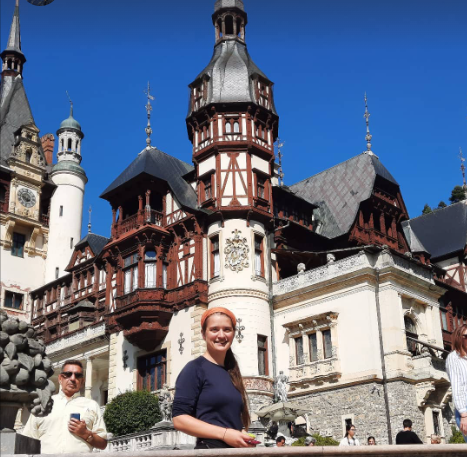
Standing outside of Peles Castle, Romania

PREPARATION

 Pre-departure preparation consisted of:

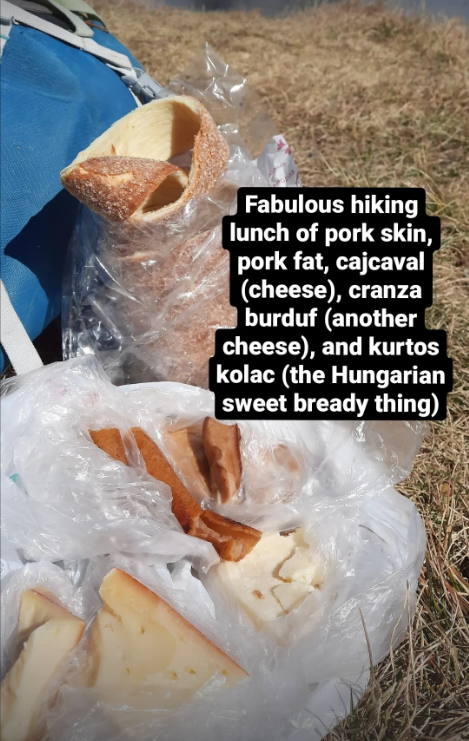
1. Researching Romanian cheeses

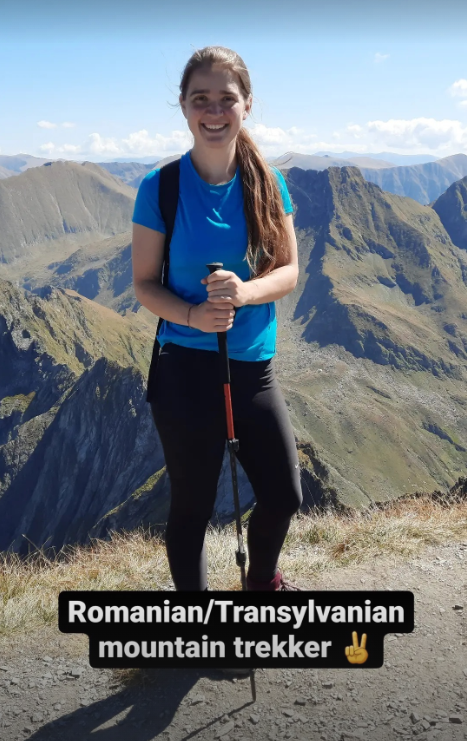
2. Researching hiking, via ferratas, mountain biking, etc. that's accessible by public transit

3. Realizing there's almost nothing accessible by public transit outside of Bucharest so contacting outdoor tour companies instead

4. Booking tours and planning daily itineraries for all 2.5 days in Romania

5. Finding and booking a hostel

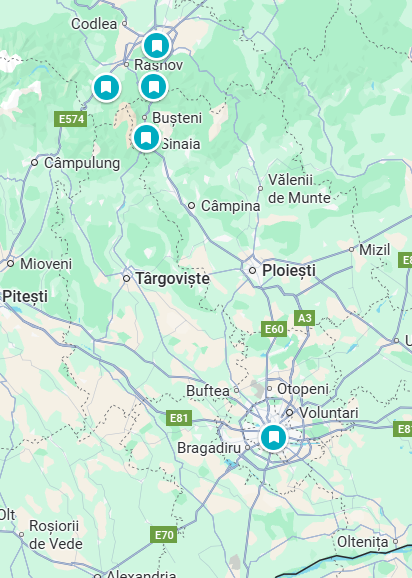
6. Mapping out how to get everywhere

The "adventure company" I booked with was lovely. Since I'm only one person and this kind of tour often takes quite a bit of work from the guides, I decided to email ahead of time to ask which already-booked tours they had going that I could tag onto. 

No response. 

For several days.

Finally, I called instead and the slowest, sweetest, quietest man's voice answered the phone. Something about how he spoke gave the clear impression that this is someone who doesn't "internet" very much; this is someone who exists 100% in the physical here and now. Turns out the only other booked tour they had this weekend was Saturday, which couldn't really work for me because I was arriving around 1:30am Saturday morning so leaving 4-5 hours later for a day of physical activity probably wasn't the best idea. Also, what I was interested in seeing didn't completely fit the tours. I'd been expecting to skip some of the things but this man, in the middle of a phone conversation, crafted a completely new tour covering all of it for just 30chf more than the other tours. Also, the only payment accepted was either cash or a Romanian bank transfer (honestly I'm not surprised?).

Now. Ready for a recount of the worst hostel EVER?! 

WORST HOSTEL EVER PART 1

I typically arrange all the essentials before arriving. The booking site I use gives the option for late check-in after midnight, which I select. Flight arrives after midnight. On arrival, I find an email sent *while I was in the air* that they're closing at midnight. I show up anyway because it's now after midnight and everything else is closed. It's completely dead and locked. I start Googling hostels and searching the streets of Bucharest for anything open. Everything is closed, full, or >200chf/night (way outside my price range - only fancy hotels have 24h reception). 

By 3am, I start looking for grass patches and benches. 

By 4am, I'm laying on a park bench trying to fall asleep with one eye open. 

By 4:30am, a group of young men comes to investigate but runs away as soon as I sit up. 

By 5am, it is FUCKING COLD and I root around my bag for anything that will cover me. 

By 5:30am, a group of cats get in a small fight nearby. 

By 6am, pigeons start to show up and form groups. 

By 6:30am, I get up in search of coffee to warm up. 

By 7am, I am at the meeting point for my tour leaving at 8am. 

The tour van arrives 20 minutes late. At least the seats are soft and it isn't freezing anymore.


DAY 1: Peles, Brasov, Vampyres, and More

The tour guide is so excited about his job, I feel guilty for falling asleep in the van seats regularly. This man is truly the ideal person for a tour guide: happy, energetic, loves where he is, wants to get us excited about it, full of stories with plenty to say.

Peles Castle

Bulz, a traditional Romanian meal featuring local cheese and bacon cooked into polenta with an egg on top

Brasov
Bran Castle, the inspiration for Dracula's castle

A priest's box of tools for fighting the demons of Transylvanian folklore, including a wooden stake to drive into the hearts of vampires.

It's a full day tour, which is great. We also covered quite a lot of ground:


WORST HOSTEL EVER PART 2

I'd been emailing the hostel during the day to assure them I'd arrive much earlier tonight but hadn't heard anything back. I show up around 9, they are open, the woman working invites me in, and she assures me it will only take a few minutes. After a while, she tells me they cancelled my booking because I "didn't show" last night. I say I haven't heard anything from them and ask if they were ever planning to tell me that they cancelled my booking. She apologizes and offers the couch in the common area. I accept (it's now 10pm and where else can I go?), but she needs to confirm with her boss. 

I wait half an hour while she deals with someone else. I inquire about the confirmation, explaining I had no place to sleep last night either because of them and am not keen to repeat that. She then contacts her boss, who tells her I cannot stay on the couch because they can't charge for that, but they have beds available tomorrow night if I want to pay some extra. 

Is this a joke?!

Leaving the hostel around 11pm, once again with nowhere to stay, I receive a new email informing me of the cancelled booking. So they overbooked but didn't cancel my booking until after I showed up.

Is. This. A. Joke.?!


A PLEASANT END TO SHITTY HOSTEL PART 2

After 45min of wandering into, calling, and being turned away from numerous fully-booked hostels and hotels, it is nearing midnight and I stop into a 24h shop to find water. 

The cheerful old security guard in the shop discovers my Romanian is limited to about 4 words. I hear him talking to the two younger cashiers, who are giggling awkwardly and offering him helpful English phrases like "nice to meet you." I hope they don't start talking to me; I'm sure they are lovely but I am so stressed out right now and can't handle new social interactions that don't move me closer to having a place to sleep tonight, however well-intentioned they may be.

On my way to the cash register with water in hand, the old security guard steps confidently into my path with a huge grin wide across his face. 

"NIGH TO EAT YOU!" He shouts loudly and proudly. The two cashiers immediately burst out laughing, covering their faces and looking away in embarrassment. Briefly frozen in surprise, I can feel a smile start to work its way onto my face.

"Nice to meet you, too," I respond, and feeling a bit lighter.

"WHAT OH NAY?" He continues.

"Sorry?" I ask, confused, and glancing at the cashiers.

"What's your name," one of them clarifies, still embarassed.

"Ahh, my name's Anneke," I answer the security guard while handing the waterbottle and cash to the cashier.

"NICOLA?" he tries to repeat my name, "MAN NAME. NICOLA MAN NAME."

Everyone's laughing now but before I can say anything, the cashier starts scolding him in Romanian. I start to leave, thanking them for the water. They smile, wave, and I continue the quest for a bed while feeling much better.

The cheapest hotel I can find that still has room is a bit outside my budget (200 Romanian lei/night = 50 CHF = 75ish CAD) but I need a shower and a bed. By 1am, I am in a clean bed with an alarm set for 6 to get to my 6:30 tour on time.


DAY 2: Mountains and Cheeses and Communism Oh My!

The best way to depict this day is through photos because it was so darn lovely. To start, Nicu picked me up at 6:30 and we drove several hours to get into the mountains. Driving through tiny Romanian villages, Nicu told me about how the communities changed dramatically before, during, and after foreign occupation, communism, and the following onslaught of capitalism. 

Once arriving in the Fagaras mountains, we paid much more attention to the scenery. The Transfaragasan highway is supposedly "the most beautiful highway in the world." On our way up, we also came across some sort of marathon, a local cheese and meat market, and some fucking fantastic views.


On the long drive back, Nicu tells me more about his family, his life, and Romania's extremely difficult relationship with communism and capitalism. On the one hand, entire villages were destroyed when communism came in. Yes, the people were evacuated and given homes elsewhere, but their real homes were gone. People felt a sense of peace and security in that they were guaranteed work and food, but it wasn't always the specific work they wanted, or the quality wasn't as high. Then the revolution against communism was extremely violent in the cities (the countryside hardly noticed a difference). The years immediately following communism were even more difficult than the communist years for many people because suddenly they were left entirely on their own to navigate not only work and livelihood, but also the sudden and tremendous onslaught of foreign Western media that essentially "took over" society. Many older people now are the ones who look back fondly on communism because they are the ones who lived through both the cruel stability of communism and tumultuous instability of its fall to capitalism and Western media.

Nicu also recommended the best place to find cheese in Bucharest and probably all of Romania: Otpor Market. Apparently, this market used to be downtown but was pushed out because city planners didn't like the mess of having the livestock bought and sold in the middle of the city. Sadly, there is no longer livestock for sale at the market but you still have to make your way to the very edge of the city to find it.

DAY 3: Bucharest

Since I'm actually based out of Bucharest for this entire weekend, you'd think I should spend at least one day here, right? That was Monday.

Waking up, I decided to find and explore Otpor Market before my walking tour at 10. Navigating the confusing city transit, I finally found the massive building and endless stands outside... only to discover it opens at 9.

Are. You. Kidding. Me.?

I wandered around drinking coffee until 9, scrambled through to find the cheeses, bought them, then booked it back to the tram to make it to the National Theatre (tour meeting point) by 10.

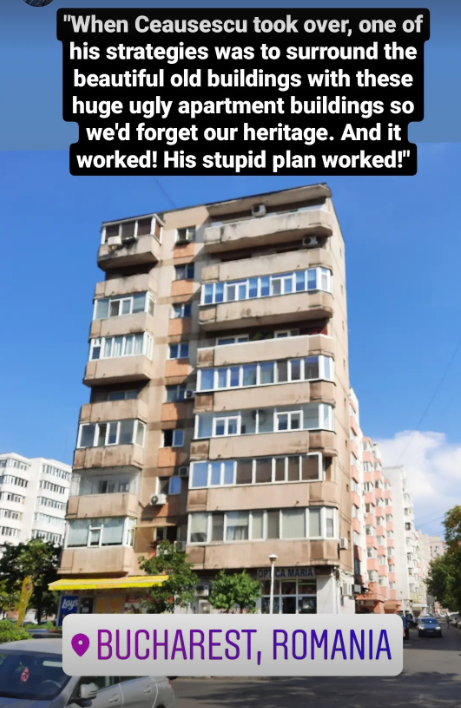
This tour guide was much less politically nuanced than Nicu. She was very direct in her bold statements about Romanian culture and identity dying under communism, the ugly buildings built by the communist leader Ceausescu that overshadowed the true Romanian architecture, lamentations about the deliberate communist neglect of the beautiful old buildings, etc.


A communist-era building and a quote from the tour guide.

But many old buildings did manage to survive; this one is the French consulate.


Oldest graffiti on the street: "Vote for the Sun" from the pre-communist 1940s. A sun was the symbol of the communist party at the time.

After the tour, I finally found mici and papanasi :)

Mici: Romanian grilled skinless sausages made with ground meat and spices

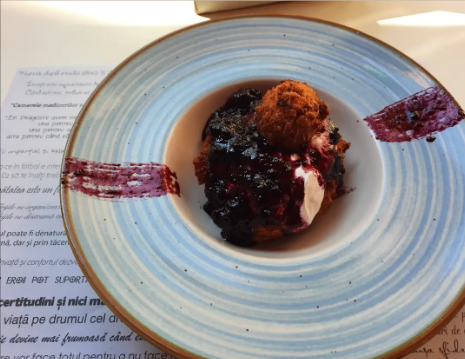
Papanasi: a fried dough ball covered in a yogurt-like cream (sour cream?) and blackberry jelly

WORST HOSTEL EVER PART 3

You would think the story of the goddamn hostel would be done by now, right? Right??

After flying back to Geneva and checking into my bank account, I discover the goddamn hostel had the AUDACITY to actually CHARGE ME for all three nights they didn't let me stay. IS THIS A JOKE?!?! Seriously. I love hostels but these are the types of places that give them a bad name. Go fuck yourself, Paris Hostel.